SeoulTech Researchers Develop Smarter Way to Handle Tokens in Long-Context AI
PR Newswire
SEOUL, South Korea, Nov. 23, 2026
SLAKE can be integrated into existing AI models to process lengthy texts faster and use less memory, without retraining
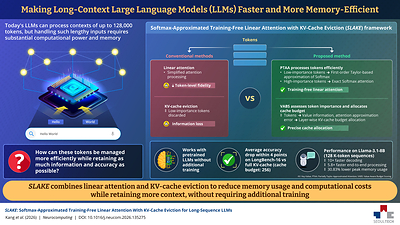
SEOUL, South Korea, Nov. 23, 2026 /PRNewswire/ -- The amount of information an AI model can process depends on how many tokens it can handle. Efficient token management is therefore important for maintaining accuracy while reducing computing costs. Researchers at Seoul National University of Science and Technology have developed SLAKE, a training-free method that can be incorporated into existing AI models. Unlike conventional methods that discard less important tokens, SLAKE retains an approximate representation of their information, while processing important tokens more precisely.
When we give a large language model (LLM), such as GPT-4, Llama, or Mistral, a task such as summarizing a lengthy research paper or a conversation, it first breaks the text into smaller units called tokens. The model then processes these tokens to understand the text and generate a response. Today's LLMs can process inputs exceeding 128,000 tokens. However, processing such long inputs places considerable demands on computing power and memory.
Two common approaches help reduce these demands. One discards less important tokens to save memory, while the other simplifies calculations of relationships between tokens to reduce computing requirements. However, discarding tokens can cause information loss, while simplifying calculations can affect model accuracy.
To overcome these limitations, a research team led by Professor Hyun Kim, alongside Dahun Choi and Huibeom Kang—who conducted the work at the Department of Electrical and Information Engineering at Seoul National University of Science and Technology (SeoulTech), Republic of Korea, and is now a machine learning researcher at ENERZAi—has developed Softmax-Approximated Training-Free Linear Attention with KV-Cache Eviction (SLAKE). Instead of discarding less important tokens entirely, SLAKE retains an approximate representation of their information while keeping the most important tokens intact.
This paper was made available online on October 1, 2026, and will be published in Volume 709 of the journal Neurocomputing on January 14, 2027.
"With SLAKE, the model keeps a rough but useful picture of the entire context instead of losing parts of it outright, so far less information is lost than with conventional eviction, while memory use stays small and fixed," explains Kang, the first author of the paper.
SLAKE combines two techniques. Partially Taylor-Approximated Attention (PTAA) uses a Taylor-based approximation to simplify attention calculations for less important tokens while keeping standard calculations for key ones. Value-Aware Budget Scoring (VABS) determines which tokens to keep in limited memory based on their contribution to the final response. Because it preserves standard attention for key tokens, SLAKE works directly with existing pretrained model weights without additional training or architectural changes.
Tested on a Llama-3.1-8B model with 128,000-token inputs, SLAKE generated responses up to 10 times faster, improved overall processing speed by 5.8 times, and cut peak memory use by 30.8%. On the LongBench-16 benchmark, its average accuracy remained within four percentage points of a full-memory model.
These efficiency gains could make AI services faster, cheaper, and capable of running privately on smartphones and smart-home hubs.
"Because methods like SLAKE work without retraining, these gains can be applied to existing models right away, making advanced AI affordable for small businesses, schools, and individuals rather than only large tech companies," says Kang.
Reference
Title of original paper: SLAKE: Softmax-approximated training-free linear attention with KV-Cache eviction for long-sequence LLMs
Journal: Neurocomputing
DOI: https://doi.org/10.1016/j.neucom.2026.135275
About the institute Seoul National University of Science and Technology (SEOULTECH)
Website: https://en.seoultech.ac.kr/
Media Contact
Seo-Hee Yoon
82-2 - 970 – 9166
427488@email4pr.com
 View original content to download multimedia:https://www.prnewswire.com/news-releases/seoultech-researchers-develop-smarter-way-to-handle-tokens-in-long-context-ai-302947008.html
SOURCE Seoul National University of Science and Technology


